
.png)

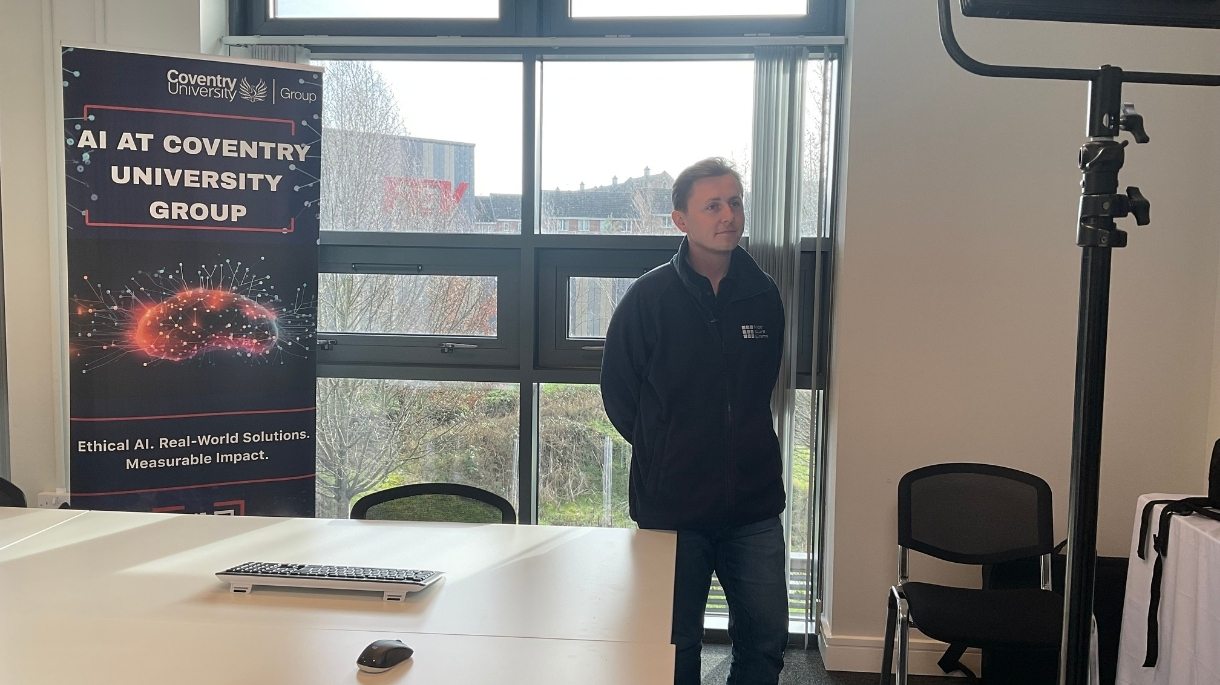
Generative AI is often framed as a creative or marketing tool, but its real value extends far beyond producing social posts or promotional materials. Attending the AI Prompt Playground, delivered by the Coventry University Group at the Simulation Centre, reinforced just how versatile AI can be when applied thoughtfully across professional and academic environments.
Rather than focusing on novelty, the session explored how AI can support enterprise productivity, helping organisations work more efficiently with data, processes, and complex information.
From simple examples to enterprise application
While a marketing flyer was used as a practical demonstration, it quickly became clear that this was simply a way to show the tools in action. The techniques discussed apply equally to a wide range of use cases, including data analysis, process simplification, and large-scale document management.
By focusing on how prompts are structured and refined, the session showed how AI can be guided to support tasks that are common across many sectors, from higher education and public services to engineering and administration.
“Generative AI shows its real value when it supports enterprise productivity, not just creative output.”
.jpg)
Why iteration matters more than the prompt itself
One of the strongest messages from the session was the importance of iterative prompting. Rather than relying on a single instruction, effective use of AI comes from refining prompts, adding context, and responding to outputs in stages.
This approach improves accuracy, relevance, and usefulness, whether AI is being used to summarise reports, explore analytical approaches in spreadsheets, or draft structured documentation. AI becomes less of a one-off tool and more of a collaborative assistant that improves through interaction.
.jpg)
Supporting data and document-heavy work
A key theme throughout the session was using AI to work with information, not invent it. Examples included asking AI to suggest ways to analyse datasets, break down lengthy reports into manageable sections, or extract key themes from large volumes of text.
Used correctly, AI can reduce the cognitive load of handling complex documents, allowing professionals to focus on decision-making rather than manual processing. However, the emphasis remained firmly on human oversight, ensuring accuracy and accountability at every stage.
Keeping people in the loop
The session also reinforced an important principle: AI works best when people remain firmly in control. Generative models can occasionally produce incorrect or misleading outputs, sometimes referred to as “hallucinations”. Understanding this limitation is part of effective AI literacy.
By treating AI as a supporting tool rather than an authority, organisations can benefit from speed and efficiency while maintaining trust, quality, and responsibility.
“AI works best as a collaborator, not an authority — human judgement must always remain in the loop.”
What this means for organisations
For organisations exploring how to adopt AI, the key takeaway is clarity. AI does not need to be complex or risky when it is understood and applied with purpose. Its value lies in supporting existing workflows, improving productivity, and helping people work more effectively with information.
At Magic Square Systems, this aligns closely with how we approach technology. We focus on practical, human-led adoption, ensuring that tools are designed to fit real-world needs and environments, rather than forcing organisations to adapt to the technology.
Looking ahead
Sessions like the AI Prompt Playground highlight that AI is not just a trend, but a skill that improves with understanding and practice. When organisations invest in AI literacy, they are better equipped to use technology responsibly and confidently.
As AI continues to evolve, the focus should remain on usefulness, clarity, and human judgement, ensuring that innovation supports people rather than overwhelms them.